About the Program
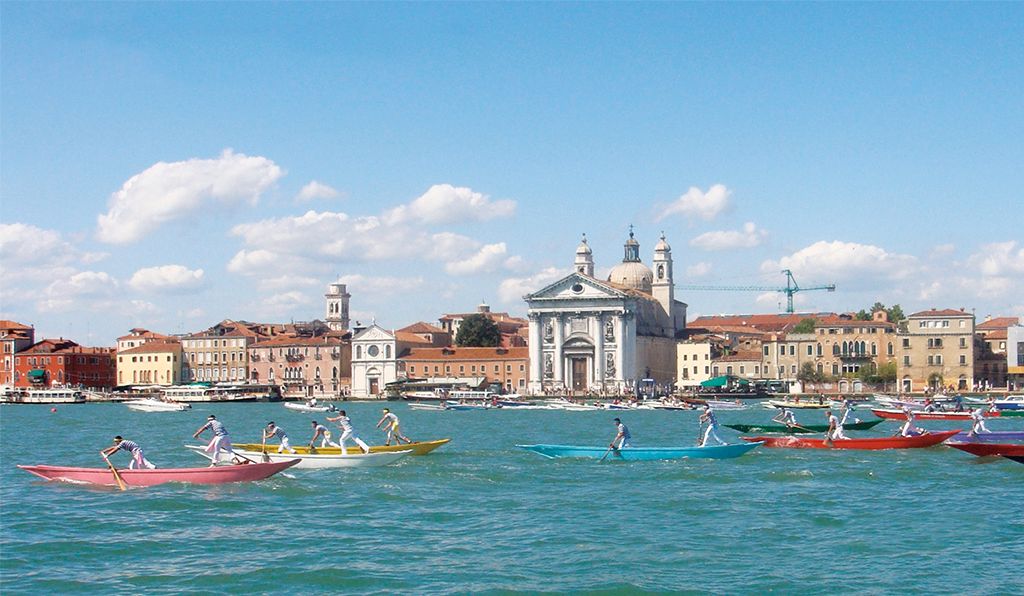
Investigate European art, culture, history, and society alongside Harvard University and Ca’ Foscari University of Venice students and faculty. This collaborative, multidisciplinary program brings together two prestigious universities to deepen your understanding of Venice—a city with a rich history and an environment unlike any other.
You experience the unique culture, art, and history of Venice through workshops, excursions, and field trips, as well as participation in the local community. With a diverse array of course offerings to choose from, you will have the opportunity to engage in a multi-disciplinary exploration of Venice and of historical and contemporary Western society.
Program Structure
The program provides essential cultural context to frame your academic experience in Venice, with a variety of required activities and workshops on topics that in past years have included Italian fashion and design, Venetian mask-making, the traditional rowing technique, Voga, and Venetian cooking.
You enroll in two of the courses listed below. Please note that final course placement is dependent on availability and is determined by the Venice program upon your enrollment.
Each course counts as one semester-long course (4 credits) of degree credit; students enroll in two courses for 8 credits total.
AAAS S-138 Study Abroad in Venice, Italy: Race and Global Migration
Glenda Carpio, PhD, Professor of English and of African and African American Studies, Harvard University
4 credits
UN, GR Limited Enrollment.
Monday/Wednesday, 12:45-3:15pm
Migration patterns have shaped reshaped states and individuals throughout history and across the world. Forced migration, produced by imperial legacies and neo-colonialist practices and, increasingly, by climate change, poses political and social challenges in both the United States and Europe. This course introduces key scholarly debates in the study of forced migration in comparative race studies, and in literature. We will investigate the causes and consequences of modern population movements from a comparative perspective by asking: what are the social, economic, and political reasons and outcomes for migration across sending and receiving countries? We will also explore how contemporary literary artists represent global migration as it intersects with race and racism in America and in Europe.
ECON S-1490 Study Abroad in Venice, Italy: Introduction to Financial Markets
Paolo Pellizzari, PhD, Professsor of Economics, Ca’ Foscari University
4 credits
UN, GR Limited enrollment.
Tuesday/Thursday, 12:45-3:15pm
The first part of this course provides an introduction to
financial markets, instruments, and trading. In the second part, modern portfolio theory is presented, touching important topics such as diversification, portfolio risk, the trade-off between risks and return, the capital asset pricing model, and the importance of the efficient market hypothesis.
Prerequisite: Precalculus. Some background on probability theory is helpful but not required.
ENGL S-36V Study Abroad in Venice, Italy: Venetian Art and the Bible
Gordon Teskey, PhD, Professor of English, Harvard University
4 credits
UN, GR Limited enrollment.
Tuesday/Thursday, 9:15-11:45am
William Blake called the Bible “the great code of art.” Nowhere was this statement truer than in the famous Italian centers of art, Rome, Florence, and Venice. But the biblical culture of Venice was special because of her rich contacts with the East: with Islam, with the Greek culture of the Eastern Mediterranean, and with the Holy Land itself. The great cathedral of Venice, Saint Mark’s, is named for the city’s patron, who wrote the oldest and most venerable of the Christian gospels. The Bible provided the artists of Venice with a rich fund of subjects for painting and sculpture. This course gives students an outline of the contents and structure of the Bible similar to what most people in Venice would have had during the period when its greatest art was produced. The aim is for students to be able to look at a work of Venetian art and read not only its biblical subject but also its biblical thinking, especially the subterranean connections between episodes. We also consider how extra-biblical subjects such as saints’ legends and episodes from the apocrypha are themselves extensions of biblical reading. Meeting times are about equally divided between classroom discussion and field trips to sites around Venice. Among the more important of these are Saint Mark’s cathedral, the Doge Palace, the Basilica dei Frari, the Scuola di San Rocco (with its amazing Tintorettos), the Basilica di Santi Giovanni e Paolo, the Basilica della Salute (with Titian’s biblical paintings in the sacristry), and the Accademia gallery, with its great hall containing Veronese’s gigantic and exuberant Feast in the House of Levi and Titian’s large but intimate Pieta,with its subtle biblical meanings adopted to personal expression. The course’s final class concludes in this room, in front of these contrasting visions of the meaning of life, seen through the lens of the Bible.
ENGL S-122 Study Abroad in Venice, Italy: Shakespeare's Venice -- Jews, Blacks, Muslims, and Christians at the Origin of the Modern World (CANCELLED)
Stephen Greenblatt, PhD, Cogan University Professor of the Humanities, Harvard University
Shaul Bassi, PhD, Full Professor of English, Ca’ Foscari University
4 credits
UN, GR Limited enrollment.
Monday/Wednesday, 12:45-3:15pm
A great early modern metropolis and a richly symbolic landscape, Venice is the setting of two seminal plays by Shakespeare, a comedy and a tragedy. The Merchant of Venice and Othello have made the Jewish moneylender Shylock and the Moor Othello the emblematic ethnic and cultural outsiders, figures who both foreshadow and challenge the modern notion of a multicultural community. This course analyzes the Shakespearean texts, reads their principal sources, and charts their controversial critical and theatrical histories. We examine the rich cultural and literary material that informs the plays, including the representations of Africans, Jews, and Muslims, and their multiple resonances in different times and places, including modern adaptations in fiction and film. Our presence in Venice is crucial to our understanding: we explore why the setting for these plays had to be here and not elsewhere, and we visit Venetian sites that illuminate the biblical, classical, and ethnographic contexts that forged Shakespeare’s notions of cultural and religious difference.
Note: Professor Greenblatt will lecture for two weeks of the course.
HARC S-140 Study Abroad in Venice, Italy: Private and Public Life in Venice, in the Renaissance and Beyond (CANCELLED)
Myriam Pilutti Namer, PhD, Adjunct Professor in the History of the Arts of Venice and the Veneto, Ca’Foscari University
Martina Frank, PhD, Professor of Philosophy and Cultural Heritage, Ca’ Foscari University
4 credits
UN, GR Limited enrollment.
Tuesday/Thursday, 9:15-11:45am
Venetian nobles in the Renaissance were remarkable commissioners of works of art and architecture as well as of literature and music. Venetian patricians were also cultured collectors of antiquities and even owners of villas and gardens on the mainland. At the same time many of them were distinguished politicians, ruling the state in order to guarantee social peace and the independence of the Serenissima Republic from other European powers. Their private life was performed in a universe of palazzi (buildings), ville (villas) and giardini (gardens), while their public role was practiced both in the Ducal Palace and the basilica of the piazza San Marco, and in the scuole (charitable organizations). The first part of the course focuses on the interaction between private and public life in Renaissance Venice. The chronology is extended to the seventeenth and the eighteenth centuries in order to explore the changes that occurred in economic and cultural life and to determine their influence on the residential behavior of the Venetian ruling class. The second part of the course focuses on a number of meaningful locations where, during the Renaissance and beyond, the boundaries of public and private sphere overlapped and blended. These case studies offer examples of critical junctions between private origins and present public use or vice versa, exploring new paradigms in the definition of space in Venice.
HIST S-1158 Study Abroad in Venice, Italy: Italy in a Global Context, 16th to 19th Centuries
Giulia Delogu, PhD, Assistant Professor of Early Modern History, Linguistics and Comparative Cultural Studies, Ca’ Foscari University
4 credits
UN, GR Limited enrollment.
Monday/Wednesday, 9:15-11:45am
This course re-examines the history of Italy in the sixteenth to nineteenth centuries through a global lens, highlighting how the Italian peninsula was not a decadent, insular region during this period, but a vital center of far-reaching networks of commercial, political, and cultural exchange. These networks reveal Italian cities as both recipients of and active agents in processes of knowledge formation. The course highlights the importance of port cities such as Venice, Trieste, and Livorno, exploring their roles in the circulation of information ranging from commercial reforms and ideas of human rights to immigration and public health policies. Students examine historical documents from the state archives of Trieste, Modena, Venice, Genoa, and Milan, as well as literary masterpieces of the period, and gain a comprehensive view of recent scholarship on Italy and the new methodological horizons of global history.
Prerequisite: none.
HUMA S-125 Study Abroad in Venice, Italy: The Ethics of Identity
Jay M. Harris, PhD, Harry Austryn Wolfson Professor of Jewish Studies, Harvard University
4 credits
UN, GR Limited enrollment.
Tuesday/Thursday, 12:45-3:15pm
This course engages with the ethical challenges presented by personal and group identities. Built around K. Anthony Appiah’s book, The Ethics of Identity, in conversation with his predecessors, interlocutors, and opponents (among them Kant, Mill, and Rawls), the course focuses on contentious contemporary issues regarding inclusion and exclusion, and on how we can engage with our multiple identities in ethically responsive ways.
VISU S-168 Study Abroad in Venice, Italy: Designing Augmented Reality Experiences for Museums and Cultural Sites
Fabio Pittarello, PhD, Associate Professor in Environmental Sciences, Informatics and Statistics, Ca’ Foscari University
4 credits
UN, GR Limited enrollment.
Monday/Wednesday, 9:15-11:45am
The course teaches students how to create a user experience (UX), based on augmented reality (AR) technology, targeted to cultural heritage sites and art exhibitions. Theoretical lectures are complemented by lab sessions focused on different methodological and technical issues involved in the development of an AR-based UX. The scenario for the development is one of the exhibitions or cultural heritage sites available in Venice at the time of the course—for example, the exhibition spaces of Ca’ Giustinian (on the south side of Ca’ Foscari), the Svevo Museum in Trieste, or Modus, a collateral event of La Biennale Arte. Students collaborate in small working groups for creating the final prototype.
Prerequisite: none.
Where You'll Live and Study
The lagoon city of Venice, la Serenissima, was for centuries a cultural and commercial center of Europe, and a vital link between East and West. Now it is the site of an educational crossroads and this multidisciplinary program that brings together students and faculty from Harvard University and Ca’ Foscari University of Venice.
While the program is in session, personal travel outside of Italy is not allowed.
Accommodation
You stay in the newly renovated dormitory “Camplus” in the Santa Marta area, about a 5-7 minute walk from the classrooms and the Summer School office in Venice. All rooms are doubles and have air conditioning and internet. With the exception of breakfast, which is provided in the dorms, you are responsible for your own meals. All rooms include a kitchenette so that you can cook your own meals.
Venice has many restaurants, bars, cafes, and pasticciere. You have the opportunity to shop at the local markets and frequent the restaurants and bars in your neighborhood. Cafeterias offering low-cost meals are another popular option.
Application
To apply, you must:
- Be at least 18 years old
- Have completed at least one year of college or be a first-year student
- Be in good academic standing
Students enrolled at any accredited university are welcome to apply. See the How to Apply page for more information.
The Summer 2024 application is now closed. All admissions decisions will be released on March 1.
Each program has unique requirements included in the online application. Beginning your application early is the best way to ensure that you have sufficient time to review and complete the application requirements by the deadline.
You may apply to no more than two programs; if applying to two programs, you will be asked to rank your two applications in order of preference (first and second choice). Any applications submitted in excess of the maximum of two will be automatically withdrawn. You will be notified of your admissions status in each program in early March.
A complete online application includes:
- Basic personal information
- A statement of interest
- Your most recent transcript
- Program-specific requirements (if applicable; may include letters of recommendation, etc.)
Interviews may be requested at the discretion of the program.
Be sure to read about the funding options available for Harvard Summer School Study Abroad programs.
If you have questions about the application, please contact the Harvard Summer School Study Abroad Office by email at summerabroad@summer.harvard.edu.
Cost & Expenses
The program fee includes:
- Tuition
- Accommodations
- Scheduled program activities
- Some meals (the program will provide further details)
You will also need to budget for a number of expenses not covered by the program fee. The amounts listed below for these out-of-pocket expenses are approximate, and you may incur additional expenses not noted here. Your actual expenses will depend on a number of factors, including personal spending habits and currency exchange rates. Note that expense categories–especially airfare–may be subject to significant fluctuations.
- International airfare ($1,600 – $2,000)
- Ground transportation ($200)
- Meals ($2,000)
- Personal expenditures, communications, course materials, and miscellaneous ($600)
If you have specific questions about personal budgeting, please contact the program directly.
See Funding and Payment for information on how to submit payments and funding options.
Additional Information
- Questions? Email venice@summer.harvard.edu
- Need an accommodation? See Students in Need of Accommodations to request one through the Accessibility Services Office.
- Accepted to the program? See Admitted Students for information about predeparture requirements.