This is an archive. See the current website at www.summer.harvard.edu.
This page contains content from the Summer School 2009. For current information, visit the Harvard Summer School website at www.summer.harvard.edu.
Information on the programs being offered summer 2010 will be available online in early September.
Faculty from Harvard and Ca’ Foscari Universities
(8 credits: UN, GR) Limited enrollment
Program dates: June 18–July 31
Application deadline: February 27
Cost: $7,350
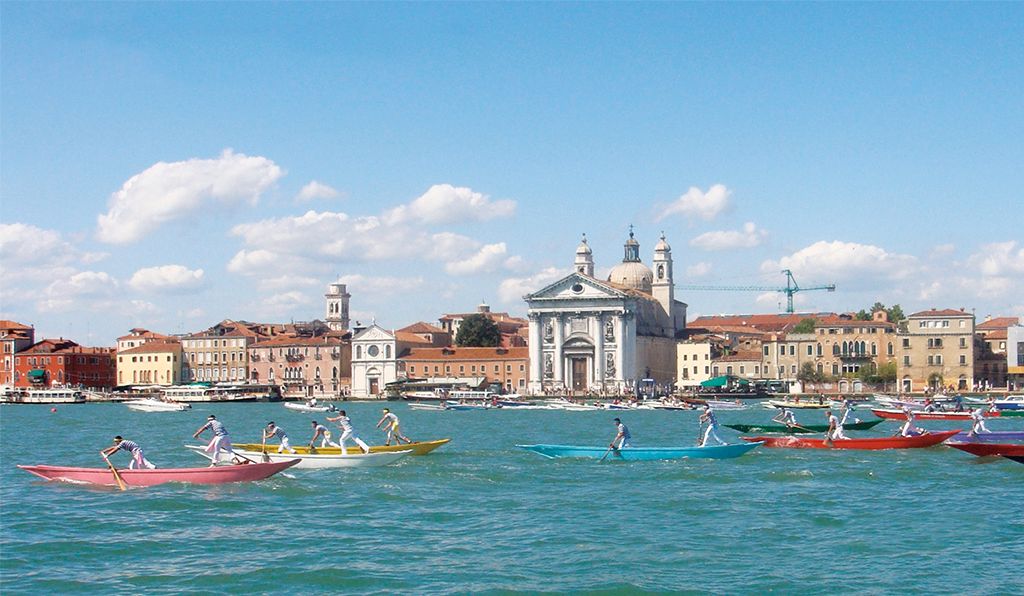
The lagoon city of Venice, la Serenissima, has for centuries been the cultural and commercial nexus of eastern and western Europe. Now it is the site of an educational crossroads as well with a multidisciplinary program that brings together students and faculty from Harvard University and Ca’ Foscari University of Venice. The program offers courses in a range of fields, including economics, environmental science, and the humanities. In addition to classes, a carefully designed program of activities brings students into the local community and promotes their understanding of Venice as a city with a rich history and an environment unlike any other.
In this program, Italian students study and learn alongside Harvard students so that all may develop a deeper knowledge of the city and of each other. Students are encouraged to pursue—through a range of guided activities—projects on the culture, art, and history of the city, using Venice as a case study for the coexistence of different traditions; projects on Venice in its former position as the Queen of the Adriatic at the center of an empire; and projects on different Venetian environments (for example, city architecture or the lagoon and its protected species). Workshops on art-and-craft forms specific to Venice are offered.
Students choose two courses for credit from a curriculum spanning environmental studies, economics, and the humanities. Noncredit Italian language instruction is also provided.
ANTH S-1882 Study Abroad in Venice: Cultural Studies—China and the West
This course, taught by Marco Ceresa, uses an interdisciplinary approach to cultural studies to examine salient aspects of Chinese society, particularly in reference to Venetian and other Western cultural institutions. Topics include European-Asian cultural flows, colonial histories, postcolonialism, neocolonialism, and cultural globalization in the East Asian region. The course aims both at creating a deeper understanding of China by challenging much of the conventional wisdom about its relationship to Venice in particular and the West in general, and at developing the students' analytical skills in cultural studies as a distinct discipline. Prerequisites: none.
ECON S-72 Study Abroad in Venice: Economics—A Critical Approach
This course, taught by Stephen A. Marglin, first presents standard microeconomics as both a description of the world and a normative argument that the market system works well for people. The second part of the course presents a series of critiques both of the descriptive and of the normative claims of standard microeconomics. These include (1) a critique internal to mainstream economics, based on the presence of monopoly, externalities, public goods, and asymmetric information; (2) a critique deriving from the distribution of income and wealth; (3) a Keynesian macroeconomic critique offering an alternative view of how overall output, income, and employment are determined; (4) an ecological critique focusing on climate change and resource shortages; (5) a foundational critique which examines the assumptions of mainstream economics and how these assumptions mold the discipline, both the questions mainstream economics asks and the answers it offers. A recurrent question in the course is the appropriate scope of the market. Examples, drawn from both microeconomics and macroeconomics, emphasize issues likely to be relevant over the coming decades: trade liberalization, health care, social security, and global warming. Prerequisites: none.
ECON S-1146 Study Abroad in Venice: Introduction to Financial Econometrics
This course, taught by Monica Billio, provides an introduction to econometric techniques used in the analysis of financial data. Students are introduced to the problems arising when using financial data, and by the end of the course they understand and critically evaluate models for asset return processes. Topics include nonlinearities in financial data, predictability of asset returns and empirical analysis of equilibrium models, econometrics of the efficient frontier, and different approaches to measuring risk. Prerequisites: coursework in statistics.
ECON S-1472 Study Abroad in Venice: Urban Management
European urban systems are in a stage of transition. A number of factors, such as the shift towards a knowledge society, globalization, and the ITC evolution, offer many challenges. These opportunities can only be used if the metropolitan regions are managed adequately. The course, taught by Jan Van Der Borg, offers students the principal ingredients of a modern urban policy that renders development of cities sustainable: from strategic planning to city marketing; from project financing to infrastructural policies. Venice, an urban laboratory, serves as a continuing point of reference during the course. Prerequisites: none.
ECON S-1749 Study Abroad in Venice: International Corporate Finance
The course, taught by Guido Mantovani, explains how financial decisions may contribute to corporate value creation. Buying and selling securities and funding is very different from trading goods. The course aims to give some insights in order: (1) to have an overview of corporate financial dynamics (as represented in balance sheets for historical data and as expected by corporations in planning procedures); (2) to understand the relationship between the corporation and the financial system (maximizing profits is not maximizing value); (3) to set up correct criteria for capital budgeting decisions (widely used methods vs. the net present value approach); (4) to define an optimal risk-return performance (fixing a capital asset pricing model along with a corporate cost of capital model); (5) to undertake wise policies for best funding of corporation investments (mix equity and debt and the limits in debt funding). Prerequisites: Economics S-10ab or the equivalent; college algebra.
ENGL S-88 Study Abroad in Venice: Interracial Literature
This course, taught by Werner Sollors, examines a wide variety of literary texts on black-white couples, interracial families, and biracial identity, from classical antiquity to the present. Works studied include romances, novellas, plays, novels, short stories, poems, and nonfiction, as well as some films and examples from the visual arts. Topics for discussion range from interracial genealogies to racial "passing," from representations of racial difference to alternative plot resolutions, and from religious and political to legal and scientific contexts for the changing understanding of race. Prerequisites: none.
ENGL S-141 Study Abroad in Venice: The Enlightenment Invention of the Modern Self
Instructor Leo Damrosch presents a study of major eighteenth-century autobiographical, fictional, and philosophical texts that explored the paradoxes of the modern self at a time when traditional religious and philosophical explanations were breaking down. In addition to philosophical writings by Locke and Hume, readings (abridged as appropriate) include Mme de Lafayette’s The Princesse de Cleves, Voltaire’s Candide, Boswell’s London Journal, Diderot’s Jacques the Fatalist, Rousseau’s Confessions, Laclos’ Liaisons Dangereuses, Casanova’s Story of My Life, and poems by William Blake. The course closely resembles one that has been offered for the past twelve years at Harvard, but in honor of its Venetian venue it gives expanded attention to Rousseau, who spent a crucially formative year in Venice, and to Casanova, who was born there and later imprisoned there until he made a daring escape. Prerequisites: none.
ENGL S-144 Study Abroad in Venice: Tales of Two Cities—Imagining Venice and London
This course, taught by Flavio Gregori and Shaul Bassi, examines the multiple ways in which cities generate texts and texts generate cities, focusing on the case studies of Venice and London. Topics include the city as a space of the imagination and representation; the city as stimulation of the writers' imagination as proxy of the city dweller (blase, flaneur, mass-mensch [mob], consumer, etc.); experience as story; the city landscape as topography of the mind; the city and the construction of identity; the cosmopolitan and gendered city; multicultural neighborhoods and ghettos. Through a wide variety of texts the course follows the transformation of Venice from early modern metropolis to postmodern simulacrum, and the emergence of London from peripheral European capital to global cosmopolis. The course looks at plays, novels, short stories, travel narratives, poems, as well as visual texts by both classical and contemporary authors (ranging from Shakespeare to Dickens, from Swift to Goldoni, from Jeanette Winterson to Tiziano Scarpa). The course also involves some fieldwork in Venice. Prerequisites: none.
ENVR S-133 Study Abroad in Venice: The Earth’s Climate—Present, Past, and Future
This course, taught by Carlo Barbante, deals with past, present, and future climate changes as evinced from the most recent studies on palaeoclimate archives, such as marine sediments and ice cores. The techniques available for the study of climate are carefully reviewed and the most recent results are presented. Climate changes involve multiple interactions among different components of the climate system, such as the atmosphere, the ocean, the earth, the biosphere, and the ice sheet. One way to make sense of this complex system is to understand the inherent rate at which each of its components respond both to the primary causes of climate change and as part of a web of interactions within the system. Testing of hypothesis by means of climate models strongly supports the experimental data presented in the course. Prerequisites: none.
HARC S-152v Study Abroad in Venice: Topics in Italian Renaissance Art
This course, taught by Frank Fehrenbach, focuses on major concepts, works, and the contexts of Italian painting and sculpture between roughly 1300 and 1600. The course provides a framework of main artistic developments on the peninsula, and concentrates on key notions like classicism, art and science, style, competition of the arts, uniqueness and reproduction, portraiture, and mannerism, rather than act as a survey course. Additional and regular visits to major works of Venetian Renaissance art are an important part of the course. Prerequisites: none.
HIST S-1581 Study Abroad in Venice: Between Inclusion and Exclusion—the Jews of Venice in the Age of the Ghetto
Established in 1516, the ghetto of Venice was to give its name to all such subsequent ethnic enclosures in modern history. In opting for the segregation, instead of the expulsion of the Jewish community, the Venetians acted in their own economic self-interest. As a matter of fact, separated from the Christian population of the city, although not isolated from it, the Jews developed their own communal institutions, a complex system of religious and social practices and they elaborated and articulated a rich cultural and intellectual life. The course, taught by Michela Andreatta, examines the most relevant aspects of the Venetian Jewish experience in the age of the Ghetto from both Jewish and non-Jewish perspective. Through the examination of documentary, literary, and artistic sources we explore the factors which amalgamated to make sixteenth–eighteenth century Venetian Jewry unique in the context of the European diaspora. Prerequisites: none.
LITR S-118 Study Abroad in Venice: Art and Money (and Venice)
What has art to do with money? That is the interdisciplinary question for moral, political, and aesthetic reflection of this course, taught by Marc Shell. Our texts frequently concern Venice or locate themselves in Venice as a means to study larger cultural issues at work, beginning with Shakespeare’s masterful The Merchant of Venice. In class we observe hundreds of paintings and other artworks with a focus on monetary themes and consider the role of museums, banks, mints, and other institutions in the Western tradition in iconographic and economic terms. Digital presentations and visits to museums are in order. Readings include works by John Locke, Isaac Newton, Irwin Panofsky, Walter Benjamin, Sigmund Freud, and others. The course closes as it began, with the reading of a play by Shakespeare, A Winter’s Tale, with commentaries and its profound Italian contexts. Prerequisites: none.
LITR S-157 Study Abroad in Venice: From Type to Self in the Middle Ages
It has been argued that the poetic "I" in premodern literatures is not a vehicle for self-representation, but an archetype of the human. The course, taught by Luis M Girón-Negrón, examines this thesis against the rise of autobiographical writing in medieval and early modern Europe. Readings include spiritual autobiographies (Augustine, Kempe, Teresa of Avila), letter collections, maqama literature, troubadour lyric, Hispano-Jewish poetry, pilgrimage narratives, medieval allegories, Dante and the picaresque novel. Theoretical perspectives by Spitzer, Lejeune, Zumthor, and DeCerteau are offered. Prerequisites: none.
For Harvard College students, this program counts as two half-year courses (4 credits each) of degree credit. ENGL S-88 counts toward the Literature and Arts A Core requirement, or satisfies the Aesthetic and Interpretive Understanding Gen Ed requirement. ENGL S-141 also counts toward the Literature and Arts A Core requirement. LITR S-157 counts toward the Literature and Arts C Core requirement. ECON S-72 counts towards the Social Analysis requirement, and HARC S-152v counts towards the Literature Arts B Core requirement.
Transfer credit. Harvard Summer School courses and credits are accepted toward degrees at most colleges and universities. Since degree requirements vary among schools, students are advised to obtain transfer credit approval from their home institutions before registering for Harvard Summer School courses.
Michela Andreatta, Lecturer in Jewish Studies, Ca’ Foscari University
Carlo Barbante, Professor of Analytical Chemistry, Ca’ Foscari University
Shaul Bassi, Associate Professor of English and Postcolonial Literature, Ca’ Foscari University
Monica Billio, Professor of Econometrics, Ca’ Foscari University
Marco Ceresa, Professor of Chinese Literature, Ca’ Foscari University
Leo Damrosch, Ernest Bernbaum Professor of Literature, Harvard University
Frank Fehrenbach, Professor of History of Art and Architecture, Harvard University
Flavio Gregori, Professor of English Literature, Ca’ Foscari University
Guido Mantovani, Adjunct Professor of Corporate Finance, Ca’ Foscari University
Stephen A. Marglin, Walter S. Barker Professor of Economics; Associate of Dunster House, Harvard University
Luis M Girón-Negrón, Professor of Comparative Literature and of Romance Languages and Literatures, Harvard University
Marc Shell, Irving Babbitt Professor of Comparative Literature and Professor of English, Harvard University
Werner Sollors, Henry B. and Anne M. Cabot Professor of English Literature and Professor of African and African American Studies; Associate of Pforzheimer House, Harvard University
Jan Van Der Borg, Associate Professor of Applied Economics, Ca’ Foscari University
Students must be at least 18 years old to apply. The application materials, outlined below, are due February 27:
Applications should be addressed as follows:
Matilda West
Study Abroad Coordinator
Harvard Summer School
51 Brattle Street
Cambridge, MA 02138 USA
Students will be notified of admission decisions by mid-March.
The cost of the program is $7,350, plus a nonrefundable $50 application fee. In addition, students are responsible for a health insurance fee ($165; waived if students have US insurance that provides coverage outside the United States) and for transportation to and from Venice. The cost of the program covers the following:
Program directors will advise students of likely additional expenses.
Harvard Summer School online services allows accepted students to make payments or deposits with a valid credit card.
Students can also mail their payment, along with a completed Study Abroad Payment Form (available in Forms), to:
Student Financial Services
Harvard Summer School
51 Brattle Street, Cambridge, MA 02138
For those admitted to the program, a nonrefundable deposit of $735 must be received by April 15 to secure a place in the program. Payment in full is due by May 15. A $100 late fee will be charged for payments received after this date.
Harvard College students are eligible for funding through the Harvard College Office of International Programs (OIP), as well as a variety of centers around campus. All Harvard Summer School study abroad programs qualify for summer funding. Programs of eight weeks or longer in duration (including extensions of Harvard Summer School Programs approved by faculty members) qualify for Rockefeller International Experience Grants; programs of shorter duration qualify for other summer grants.
Students may consult the Funding Sources Database for more information on all sources of funding. Please note that the funding application deadline for summer grants and Rockefeller International Experience Grants is February 27.
To apply for any study abroad funding, students need to provide information about the program’s budget, submit an application through the Common Application for Research and Travel (CARAT), as well as supplementary documents to the relevant center, if necessary. Additional information on the funding application process is available through CARAT.
Also see the Harvard College Financial Aid Office summer school page for information about assistance.
Other Harvard students may be eligible for financial assistance through their Harvard financial aid offices. Students enrolled at other institutions should consult their respective financial aid offices.
Students stay in dormitories at Ca’ Foscari University in Venice. All rooms are doubles and include breakfast.
Contact Matilda West, matilda_west@harvard.edu; (617) 998-8593; fax (617) 496-4525.
Students with disabilities should contact the disability services coordinator as soon as possible: (617) 495-0977, (617) 495-9419 (TTY), or disabilities@dcemail.harvard.edu. Request-for-accommodation forms and supporting diagnostic documentation must be submitted by April 15. See the Disability Services page for more information about disability services, including request forms and guidelines for documentation.
Students applying for admission to Harvard’s study abroad programs should understand that although the University provides reasonable assistance and support to facilitate the participation of qualified students in its programs (including students with disabilities and health impairments), some of our programs are located in parts of the world where accommodations may not be readily available. Students are encouraged to be forthcoming with the disability services coordinator about any specific needs and functional limitations so that the Summer School can collaborate with those students in a way that fosters their safe participation and allows them to fully appreciate any barriers that they may face, depending on the location and rigors of the particular program.
Harvard Summer School is aware of the risks associated with international travel. Should the US Department of State issue a travel warning for any of the countries in which a study abroad program is planned, the program in that country may be canceled.