At a glance
Dates:
May 31–July 28, 2012
Application deadline:
The application period is now closed.
Cost:
$7,500
Accommodations:
Dorms
See also
Contact
- Venice Summer Program, e-mail
Harvard Summer Program in Venice, Italy
Harvard Summer Program in
Venice, Italy
Liberal arts studies in Italy’s city of canals
Faculty: From Harvard and Ca’ Foscari Universities
The lagoon city of Venice, la Serenissima, has for centuries been the cultural and commercial nexus of eastern and western Europe. Now it is the site of an educational crossroads as well with a multidisciplinary program that brings together students and faculty from Harvard University and Ca’ Foscari University of Venice. The program offers courses in a range of fields, including art history, economics, English literature, Italian, and sociology. In addition to classes, a carefully designed program of activities brings students into the local community and promotes their understanding of Venice as a city with a rich history and an environment unlike any other.
In this program, Italian students study and learn alongside Harvard students so that all may develop a deeper knowledge of the city and of each other. Through a range of guided activities, students are encouraged to investigate the culture, art, and history of the city.
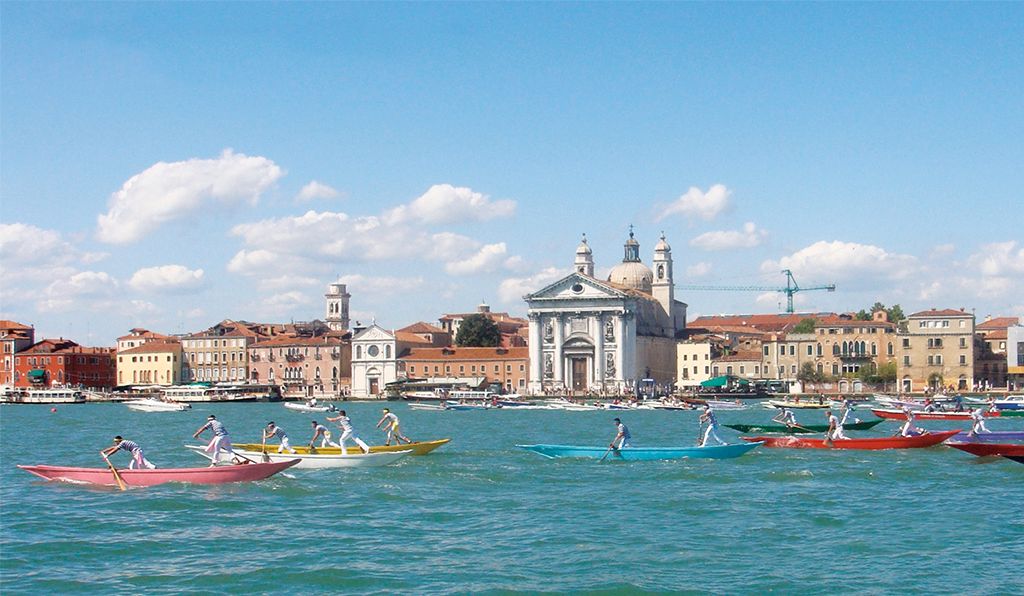
During the first 2 weeks of the session, students participate in projects designed to give a hands-on experience of Venice, such as traditional arts and crafts and activities, guided visits to places of historical interest, and other activities that give insight into the city. Past programs have included workshops in fashion, design, and Venetian masks; lessons on the traditional rowing technique Voga; and classes on Venetian cooking.
Course of study
ECON S-1749 Study Abroad in Venice, Italy: Corporate Finance (32607)
Tuesdays, Thursdays, 10 am-12:30 pmEfraim Benmelech.
(4 credits: UN, GR) Limited enrollment
This course surveys the current research in corporate finance. It covers work in the 3 main areas of corporate finance: (1) capital structure (the distortions associated with different ways of financing); (2) valuation (the valuation of projects and firms); and (3) corporate governance (optimal governance structures of firms). More advanced topics include comparative financial systems and the current financial crisis.
Prerequisites: ECON S-1010 or equivalent.
ECON S-1936 Study Abroad in Venice, Italy: Redeeming Keynes (32736)
Tuesdays, Thursdays, 1-3:30 pmStephen A. Marglin.
(4 credits: UN, GR) Limited enrollment
This course explores the birth, death, and resurrection of The General Theory of Employment, Interest, and Money from the Great Depression (1929-1939) to the Great Recession (2008-?). Keynes intended The General Theory to provide an intellectually consistent and persuasive argument that would explain the failure of a market system, even an idealized system with all of the warts removed, to provide jobs for willing workers. It is clear from its checkered career that The General Theory was at best a partial success. It is not only difficult to read, it does not make good on the promise of a clear and consistent account of why a competitive economy might fail to reach a full-employment equilibrium. This course attempts to provide the coherent argument that, for all its theoretical innovation, The General Theory did not deliver. In the process we examine the orthodoxy that Keynes attacked and that resurfaced in the 1960s and 1970s; the key concepts on which rest the models implicit in The General Theory; and the attempts of the "Keynesian" mainstream to make peace with both Keynes and orthodoxy. We also explore the applicability of The General Theory to the long run. A final section will view the present economic difficulties through a Keynesian lens.
Prerequisites: introductory economics at the level of Economics S-10. A year of college calculus will be useful even though mathematics will be used very sparingly.
ENGL S-88 Study Abroad in Venice, Italy: Interracial Literature (32137)
Mondays, Wednesdays, 10 am-12:30 pmWerner Sollors.
(4 credits: UN, GR) Limited enrollment
This course examines a wide variety of literary texts on black-white couples, interracial families, and biracial identity, from classical antiquity to the present. Works studied include romances, novellas, plays, novels, short stories, poems, and nonfiction, as well as some films and examples from the visual arts. Topics for discussion range from interracial genealogies to racial "passing," from representations of racial difference to alternative plot resolutions, and from religious and political to legal and scientific contexts for the changing understanding of race. Focus is on the European tradition and the Harlem Renaissance.
Prerequisites: none.
ENGL S-177v Study Abroad in Venice, Italy: American Literary Expatriates in Europe (32606)
Mondays, Wednesdays, 1-3:30 pmGlenda R. Carpio.
(4 credits: UN, GR) Limited enrollment
This course explores the fiction and travel literature produced by American writers living in Europe, from Henry James to the present. In the course of this period the relationship between old to new world continuously evolves. While Europe becomes the battlefield for two bloody World Wars as well as a museum of the past, the United States assumes a dominant role on the world stage. At the same time, America also betrays key fundamental ideals as it seeks to extend its sphere of influence. American writers living and traveling in Europe reflect on these shifts and changes while also exploring the complex set of contradictions that expatriate life reveals. For African American writers, for instance, Europe represents both a site of liberation from the oppression of American color codes and also an area of the world where they are often exoticized. We focus on American literature set in Europe with readings that include but are not limited to essays, travelogues, poems, novellas, novels, and short stories.
Prerequisites: none.
ENVR S-133 Study Abroad in Venice, Italy: Earth's Climate—Past, Present, and Future (32299)
Mondays, Wednesdays, 1-3:30 pmCarlo Barbante.
(4 credits: UN, GR) Limited enrollment
This course deals with past, present, and future climate changes as evinced from the most recent studies on palaeoclimate archives, such as marine sediments and ice cores. The techniques available for the study of climate are carefully reviewed and the most recent results are presented. Climate changes involve multiple interactions among different components of the climate system, such as the atmosphere, the ocean, the earth, the biosphere, and the ice sheet. One way to make sense of this complex system is to understand the inherent rate at which each of its components respond both to the primary causes of climate change and as part of a web of interactions within the system. Testing of hypothesis by means of climate models strongly supports the experimental data presented in the course.
Prerequisites: none.
GOVT S-1781 Study Abroad in Venice, Italy: International Oil Politics from the 1970s to the Present (32725)
Mondays, Wednesdays, 1-3:30 pmDuccio Basosi.
(4 credits: UN, GR) Limited enrollment
The course examines oil as a source of both international cooperation and international conflict in the late twentieth- and early twenty-first-centuries. The oil crises of the 1970s, petrodollar recycling, Third World indebtedness, Soviet decline, the 2 Iraq wars of 1991 and 2003, the Kyoto and Copenhagen negotiations on climate changes, and other relevant processes and events of recent international relations will be read through the role played by oil in each case. By analyzing a set of case studies, the course places oil politics in relation to economic, military, social, and environmental issues. By making use of primary declassified sources from public and private archives, the course aims to allow students to critically evaluate the assigned readings. At the end of the course, students will be able to assess the role of oil politics in recent and present international relations, and to display a confident knowledge of the complexities of issues such as the relationship between governments and oil corporations, oil and international finance, oil and international power, oil and the international debate on renewable sources.
Prerequisites: none. A basic knowledge of twentieth-century international relations is highly advisable.
HIST S-1940 Study Abroad in Venice, Italy: A History of Consumption (32873)
Mondays, Wednesdays, 10 am-12:30 pmGiovanni Favero.
(4 credits: UN, GR) Limited enrollment
The course aims to provide knowledge of the main discontinuities marking the evolution of consumption patterns in Europe and partially in the world from the Renaissance to the twentieth century. Particular attention will be paid to the dynamic relationship between consumption on the one hand and commercial trends, household organization, and technological change on the other. Visits to appropriate sites around Venice will complement the classroom work. Students will work with both the historical literature and primary sources to present case studies and prepare a final research paper.
HARC S-152m Study Abroad in Venice, Italy: Leonardo da Vinci (32877)
Tuesdays, Thursdays, 10 am-12:30 pmFrank Fehrenbach.
(4 credits: UN, GR) Limited enrollment
This course focuses on the main topics and developments in Leonardo's art, science, and technology, contextualizing him in the artistic, cultural and political setting of Renaissance Italy around 1500, but also in the history of appropriations from Vasari to Dan Brown. The mutual interdependence of art and science, but also the internal tensions of this relationship, make Leonardo's work particularly relevant for major trends in contemporary culture. Two 1-day excursions (Milan and Florence; dates to be announced) allow us to discuss major works by Leonardo.
ITAL S-Aa Study Abroad in Venice, Italy: Beginning Italian (32623)
Mondays, Wednesdays, 10 am-12:30 pmMichele Daloiso.
(4 credits: UN, GR) Limited enrollment
For students with little or no knowledge of Italian and no previous formal study of the language. This course aims at achieving basic communication skills and vocabulary. Emphasis is on oral expression and listening comprehension.
Prerequisites: none.
RELI S-13 Study Abroad in Venice, Italy: The Contested Bible—The Sacred-Secular Dance (32867)
Tuesdays, Thursdays, 1-3:30 pmJay M. Harris.
(4 credits: UN, GR) Limited enrollment
A short history of the Bible. Questions addressed include how the Bible became a book, and how that book became sacred; the advantages and burdens of a sacred text; Jewish-Christian disputations; how interpretive efforts helped create and reinforce powerful elites; how that text became the object of criticism; and how the Bible fared after the rise of criticism.
SOCI S-173 Study Abroad in Venice, Italy: Immigration and Multiculturalism in Venice (32622)
Tuesdays, Thursdays, 10 am-12:30 pmFrancesca Coin.
(4 credits: UN, GR) Limited enrollment
Immigration in Italy is a relatively recent phenomenon. Traditionally an emigration country, between 1984 and 1989 the diversion of immigrant flows toward southern Europe transformed Italy into a receiver of immigrants. Since the late 1980s, immigration policy became progressively more restrictive. Today, Italy is considered by most immigration experts as having some of the most stringent immigration laws in Europe. This class looks at the specificities of immigration in Italy by comparing its complex national history with a tradition of cultural hybridism at the local level. While at the national level the immigration discourse is centered on religious homogeneity and requests for stricter control practices, at the local level there emerge programs to promote multicultural expression and ethnic creativity. The Veneto region is at the forefront of these initiatives, being it both home of the conservative Northern League and traditionally a cosmopolitan area. Class includes field-trips intended to look at the various facets of immigration in and around Venice and to analyze dynamics of ethnic creativity and social integration.
Prerequisites: none.
VISU S-186 Study Abroad in Venice, Italy: Beginnings and Endings in the Fiction Film—The Case of Modern Italian Cinema (32868)
Tuesdays, Thursdays, 1-3:30 pmValentina C. Re.
(4 credits: UN, GR) Limited enrollment
Students will acquire a set of analytical tools that will help to understand how a film creates meaning. Concepts and definitions will be presented and discussed through the use of film clips, with a particular attention to modern Italian cinema from 1945 to 1975 ? Italian Neorealism, Italian Art Cinema, Young Cinema and Spaghetti Western. The analytical tools will then be used to deepen the topic of narrative closure. What does it mean that "a film does not just start, it begins," as Bordwell and Thompson state in Film Art? What kind of information can the beginning provide, and in which ways? What kind of expectations can the beginning raise? What does the resolution of a film story imply? How can discursive strategies convey a sense of closure? What do we mean by "open-ended narratives"? How does the happy ending work, and how can it be disturbed?
Course credit
See Study Abroad Credit Information.
Faculty
Carlo Barbante, Laurea, Professor of Analytical Chemistry, Ca' Foscari University
Duccio Basosi, PhD, Researcher in Linguistics and Comparative Cultural Studies, Ca' Foscari University
Efraim Benmelech, PhD, Frederick S. Danzinger Associate Professor of Economics, Harvard University
Glenda R. Carpio, PhD, Professor of English and of African and African American Studies, Harvard University
Francesca Coin, PhD, University Researcher in Sociology, Ca' Foscari University
Michele Daloiso, PhD, Adjunct Professor in English Language, Ca' Foscari University
Giovanni Favero, PhD, Associate Professor of Economic History, Ca' Foscari University
Frank Fehrenbach, PhD, Professor of History of Art and Architecture, Harvard University
Jay M. Harris, PhD, Harry Austryn Wolfson Professor of Jewish Studies, Harvard University
Stephen A. Marglin, PhD, Walter S. Barker Professor of Economics, Harvard University
Valentina C. Re, PhD, Researcher in Philosophy and Cultural Heritage, Ca' Foscari University
Werner Sollors, DPhil, Henry B. and Anne M. Cabot Professor of English Literature and Professor of African and African American Studies, Harvard University
Application
The application period is now closed.
Students must be at least 18 years old, have completed at least 1 year of college or be a first-year student, and be in good academic standing to apply.
The application materials, outlined below, are due February 3:
- A completed online application that includes:
- A $50 nonrefundable application fee
- A statement describing your overall academic interests and your reasons for wanting to study in Venice this summer. In your statement you should discuss any relevant coursework you have taken and address how you think your experience in Venice will shape your intellectual and social development
- Transcripts (student record accepted for Harvard students)
Students will be notified of admission decisions by mid-February.
Cost
There is a nonrefundable $50 application fee. The cost of the program is $7,500 and includes the following:
- Tuition
- Room and breakfast
- All scheduled excursions and extracurricular activities
In addition to the program fee, students are responsible for:
- A health insurance fee ($195; waived if students have US insurance that provides coverage outside the United States)
- Transportation to and from Venice
- The cost of passports and visas (if the latter is needed)
- Any immunizations
Suggested budget
See a sample budget for estimated expenses.
How to pay and funding options
See Funding and Payment for payment deadlines, deposit amounts, and more information, including funding options for Harvard College students.
Accommodations
Students stay in local dormitories on Giudecca Island. All rooms are doubles and do not include air conditioning. With the exception of breakfast (for which meal cards are provided), students are responsible for their own meals. Dorms have limited kitchen access. Venice has many restaurants, bars, cafes, and pasticciere. Students have the opportunity to shop at the local markets and frequent the restaurants and bars in their neighborhood. Cafeterias offering low-cost meals are another option.
Additional information
Contact the Venice Summer Program, venice@dcemail.harvard.edu.
Students with disabilities should contact the disability services coordinator as soon as possible. See Students with Disabilities for more information.